
Starting as a German freelancer generally requires no trade office registration, commercial register entry or startup capital. The central task is tax registration with the Finanzamt through ELSTER's “Fragebogen zur steuerlichen Erfassung”. This guide covers the sole proprietor questionnaire for people working alone as freelancers under Section 18 of the German Income Tax Act (EStG). Commercial businesses, partnerships and corporations have different forms and further steps.
This article explains public sources in general terms; it is not tax or legal advice. The tax office determines whether an activity is freelance or commercial based on the individual facts.
Before you begin
Trade office: qualifying freelance work under Section 18 EStG is not a commercial trade. You register with the tax office, do not pay trade tax on that work and are not automatically required to join the chamber of commerce (IHK).
ELSTER account: the questionnaire is submitted electronically. Its registration code typically arrives by post after around two weeks. Notification to the tax office should occur within one month of starting the activity (Section 138 of the German Fiscal Code, AO), so begin ELSTER registration early.
Tax ID versus tax number: your lifelong personal tax identification number already exists. The questionnaire requests an additional tax number (Steuernummer) for your freelance activity. That tax number belongs on later invoices; the personal tax ID is different.
Step 1: Find the questionnaire in ELSTER
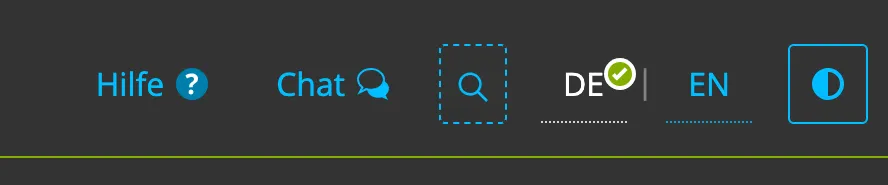
After signing into ELSTER, select Suche (search).
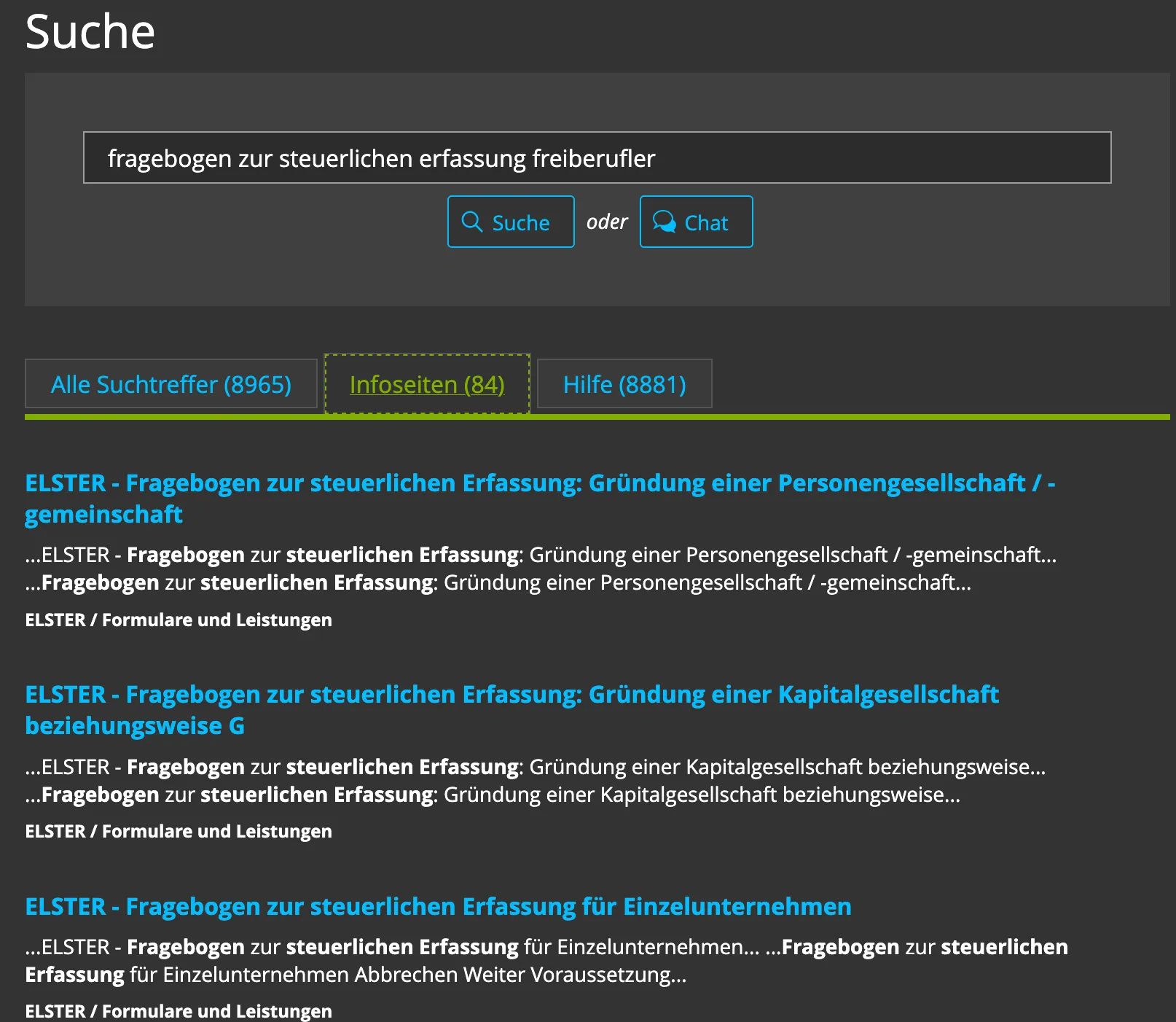
Search for “Fragebogen zur steuerlichen Erfassung”. For an individual freelance activity, select Fragebogen zur steuerlichen Erfassung für Einzelunternehmen, not the partnership or corporation variant.
Step 2: Open the form
Search first leads to an information page. Follow the link there to open the questionnaire itself.
Step 3: Choose the responsible tax office
You are requesting a new tax number. The relevant Finanzamt is generally the one for your place of residence. If unsure, use the Federal Central Tax Office's tax-office search with your postal code.
Step 4: Personal and bank details
Enter your name, address, date of birth and existing tax ID. The tax office uses bank details for refunds and, if you authorise direct debit, tax prepayments. A separate business bank account is not required for freelancers, but separate accounts simplify bookkeeping.
Step 5: Describe the activity
Describe your work briefly in “Art der Tätigkeit”. This is a significant field in the tax office's freelance-versus-commercial assessment. “Grafikdesign” or “Journalistische Tätigkeit” describes a different activity from “Agentur für Online-Marketing”. Fill in the three blanks below and give the prompt to ChatGPT or Claude to draft German wording:
What I do: [e.g. design websites for small businesses]
My training: [e.g. degree in communication design]
How I earn money: [e.g. hourly project work]

Context: I am registering as a freelancer (sole proprietor, Section 18 German Income Tax Act) with the German tax office through ELSTER's “Fragebogen zur steuerlichen Erfassung – Einzelunternehmen”. Draft the German entry for the “Art der Tätigkeit” field.

Rules:
- Write in German, using a few words and no more than 180 characters.
- Use a clear profession name, for example “Grafikdesign”, “Ingenieurtätigkeit” or “Journalistische Tätigkeit”.
- Be specific but not so narrow that later related work is excluded.
- Use plain language, no marketing jargon.
- Avoid commercial-trade terms such as Handel, Verkauf, Vermittlung or Agentur.

Give me exactly three variants to copy. If my activity seems more commercial than freelance, tell me in one sentence. The tax office decides the actual classification.
The suggestions are wording drafts, not a tax-office classification. Clarify uncertain cases before submitting.

Step 6: Estimate revenue and profit
Estimate income from your freelance activity; employment income belongs elsewhere. The Finanzamt uses your forecast to set income tax prepayments. Low initial estimates may result in no prepayments. Estimate realistically and conservatively: overestimates can cause payments against income you have not yet earned. The tax office adjusts prepayments after your first return.
Step 7: Profit calculation: EÜR or balance sheet
The options are an Einnahmen-Überschuss-Rechnung (EÜR), or income-surplus calculation under Section 4(3) EStG, and a Betriebsvermögensvergleich, double-entry accounts with balance sheet and income statement under Section 4(1) EStG. For a sole freelancer, EÜR is generally the practical choice. Freelancers are not subject to bookkeeping duties under Section 141 AO; its turnover and profit thresholds concern commercial traders. Voluntary double-entry accounts add substantial effort.
Step 8: Choose whether to use the small-business VAT scheme
The “Kleinunternehmerregelung” under Section 19 UStG can apply when previous-year turnover did not exceed €25,000 and current-year turnover is expected to remain under €100,000. In the first year, there is no previous year, so the €25,000 current-year threshold applies. Users of the scheme do not show VAT on invoices and instead add a reference to Section 19 UStG.
After submission
The tax office checks the information. A common processing period is two to eight weeks, after which the tax number arrives by post. Once you have it, include it with the other mandatory details under Section 14 UStG on invoices.
Sources and date
- Section 18 EStG: income from self-employment
- Section 4 EStG: profit
- Section 19 UStG: small-business VAT
- Section 14 UStG: invoices
- Section 138 AO: activity notification
- Section 141 AO: bookkeeping duties
- ELSTER
- BZSt tax-office search
As of 24 September 2026.
Create your first invoice
Once your tax number arrives, Rechnungstool can create German ZUGFeRD invoices for free in chat or the web app.
